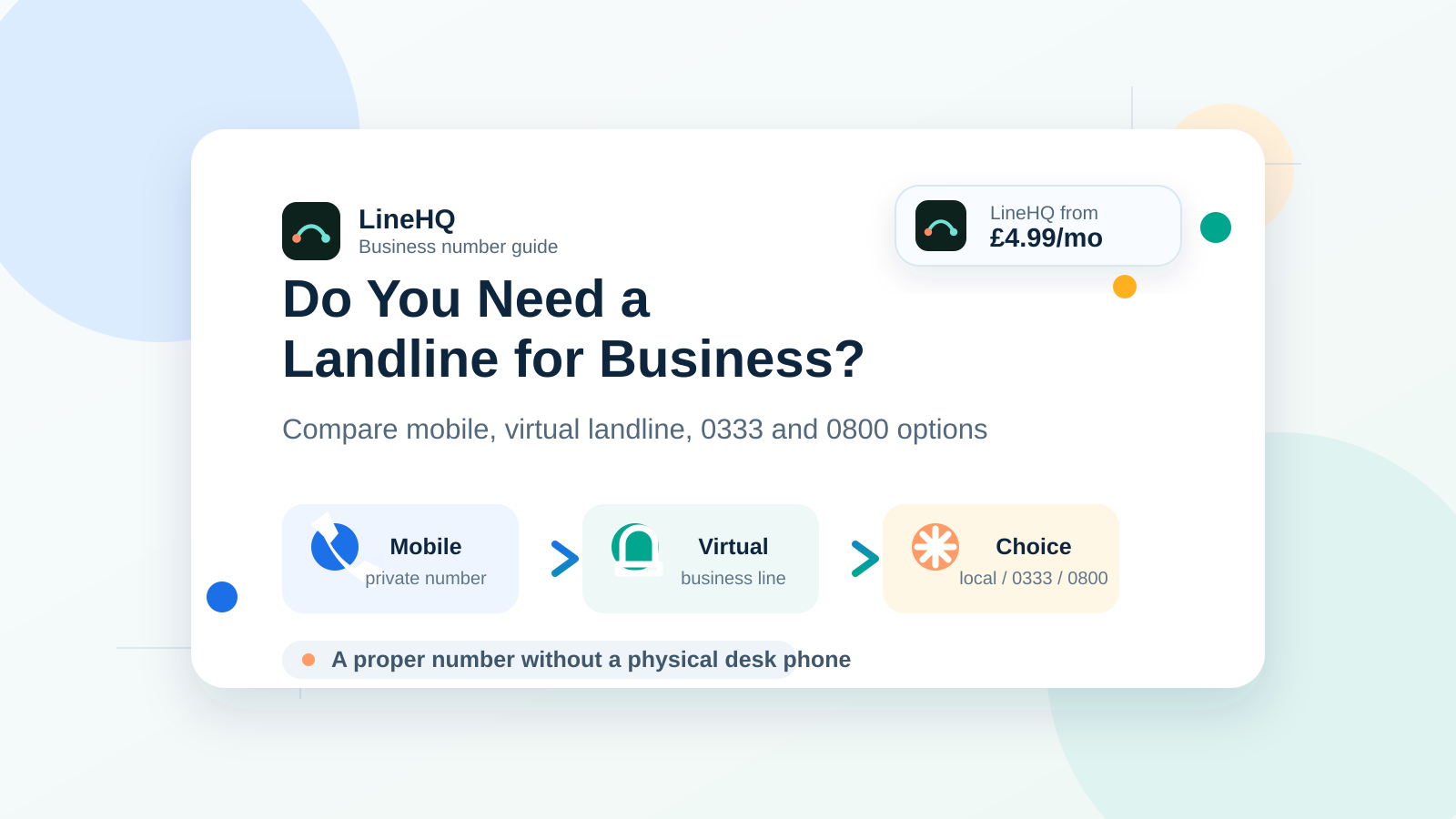
Most small businesses do not need a physical desk landline, but they often still need a proper business number. A virtual landline or business phone number can ring the mobile you already use, keep your personal number private, and give customers a more stable contact point as the business grows.
The question is not really whether a copper-line phone still belongs on your desk. It is whether customers have a reliable, professional way to reach the business without depending on your personal mobile number.
This guide compares the main options: using your own mobile, choosing a virtual landline for small business, using a local, 0333 or 0800 number, and keeping an existing number through number porting.
When a personal mobile is enough
A personal mobile can work when you are testing an idea, taking only a handful of calls, or dealing with customers who already know you. For some sole traders, that is a sensible starting point.
The problems usually appear once the business becomes busier. Your number goes on a website, van, quote, Google profile, directory listing and invoice. At that point it is harder to separate personal calls from work calls, and harder to change the number later without leaving old details scattered around.
When a mobile number starts to hold the business back
A mobile number is not automatically unprofessional. Plenty of good businesses use one. The issue is control.
| Problem | Why it matters | What a business number changes |
|---|---|---|
| Personal privacy | Your own number ends up in too many public places | The public number can forward to your mobile without exposing it |
| Missed calls | Work calls can disappear among personal calls and voicemail | Business voicemail, call records and routing make follow-up easier |
| Growing the team | Customers still ring one person even when others can help | Calls can be forwarded to different people or a simple team route |
| Future changes | Changing a personal number later can be messy | The business number stays stable while the destination changes |
What is a virtual landline?
A virtual landline is a business number that is not tied to a desk phone or old phone socket. It can forward calls to your mobile, a landline, a team route or voicemail, depending on how the account is set up.
That makes it a practical business phone number option for small businesses that want a proper number without buying a full office phone system. You can look local with an 01 or 02 number, national with 0333, or free-to-call with 0800.
Virtual landline, 0333, 0800 or mobile: which fits?
The right number depends on how customers buy from you and where you trade.
| Number type | Best fit | Useful note |
|---|---|---|
| Personal mobile | Very early-stage sole traders or private repeat customers | Simple, but poor for privacy and future handover |
| Local 01/02 number | Local firms that want a clear town or area signal | Useful for trades, clinics, local services and regional trust |
| 0333 number | UK-wide businesses that do not want to look tied to one town | Often suits online, consultancy and national service businesses |
| 0800 number | Businesses that want callers to ring free from mobiles and landlines | Useful for higher-value enquiries where caller friction matters |
| Virtual landline | Small teams that want a professional number routed to existing phones | Lets you keep the public number separate from the device that answers |
If you are not sure which route fits, LineHQ has a plain guide to 0800, 0333 and local numbers, plus a wider page for choosing a UK business phone number.
Do customers still expect a landline?
Some customers still trust a landline-style number because it feels more settled than a personal mobile. That is especially true when they are comparing companies they have never used before.
But they usually do not care whether the call is answered on a desk phone, mobile or laptop. They care that the number works, the business answers, voicemail is handled properly, and the number still exists next month.
What about the PSTN switch-off?
The UK is moving away from the old Public Switched Telephone Network, often called the PSTN. This does not mean business phone numbers disappear. It means traditional landline services are being replaced by digital phone services that use broadband or internet-based routing.
For a small business, the practical point is simple: avoid building your future contact setup around an old fixed-line socket. If your current landline number matters, check whether you can move it to a digital or virtual setup before changing provider or cancelling the old service.
LineHQ's PSTN switch-off guide explains the change in more detail, without treating it as a scare story.
Can I keep my existing business number?
Often, yes. If the number is portable and the account details are in order, you may be able to move it to a new provider instead of starting again. This is worth checking before you cancel anything.
Porting matters because customers, suppliers and directory listings may already know your number. Keeping it can protect that recognition while still giving you better routing, voicemail, call recording and follow-up tools. Start with LineHQ's guide to keeping your existing number.
What should a small business phone setup include?
You do not need to buy every feature on day one. A good small-business setup normally starts with:
- one clear public number for customers
- call forwarding to the person or team that should answer
- voicemail for missed calls
- a record of inbound calls so follow-up is not based on memory
- the option to add routing, recording or a simple menu later
That is why many small businesses start with a virtual number rather than a heavy phone system. LineHQ's call forwarding and small-business phone system pages show how this can work without replacing the phones you already use.
Simple decision guide
Use this as a quick filter:
| If this sounds like you | Best next step |
|---|---|
| You are testing a tiny side project | Your mobile may be fine for now |
| Your number is on your website, Google profile or ads | Move to a separate business number |
| You work locally and want a familiar area signal | Choose a local 01 or 02 number |
| You serve customers across the UK | Compare a 0333 number with a local number |
| You want callers to ring you free | Look at an 0800 number |
| You already have a known business landline | Check number porting before cancelling anything |
FAQ
Do I need a landline for my business?
No, most small businesses do not need a physical landline. They usually need a reliable business number that can forward to a mobile, support voicemail, and stay separate from the owner's personal number.
Is a mobile number bad for business?
Not always. A mobile number can be fine for very small or early-stage businesses. It becomes a problem when you need privacy, team routing, better missed-call handling, or a number that can stay with the business as it grows.
What is the best business landline alternative in the UK?
For many small businesses, the best alternative is a virtual landline or virtual business number. It gives you a proper public number while calls still ring through to your mobile or chosen destination.
Can I use a virtual landline on my mobile?
Yes. A virtual landline can forward inbound calls to your mobile, so customers ring the business number while you answer on the phone you already carry.
Should I choose a local number, 0333 or 0800?
Choose a local number if local trust matters, 0333 if you want a national UK feel, and 0800 if you want calls to be free for customers. The right choice depends on your customer base and how enquiries usually arrive.
LineHQ helps small businesses choose and run virtual numbers without buying a complicated phone system. Compare virtual landline options, browse business phone number types, or check LineHQ pricing when you are ready to set up a proper number.