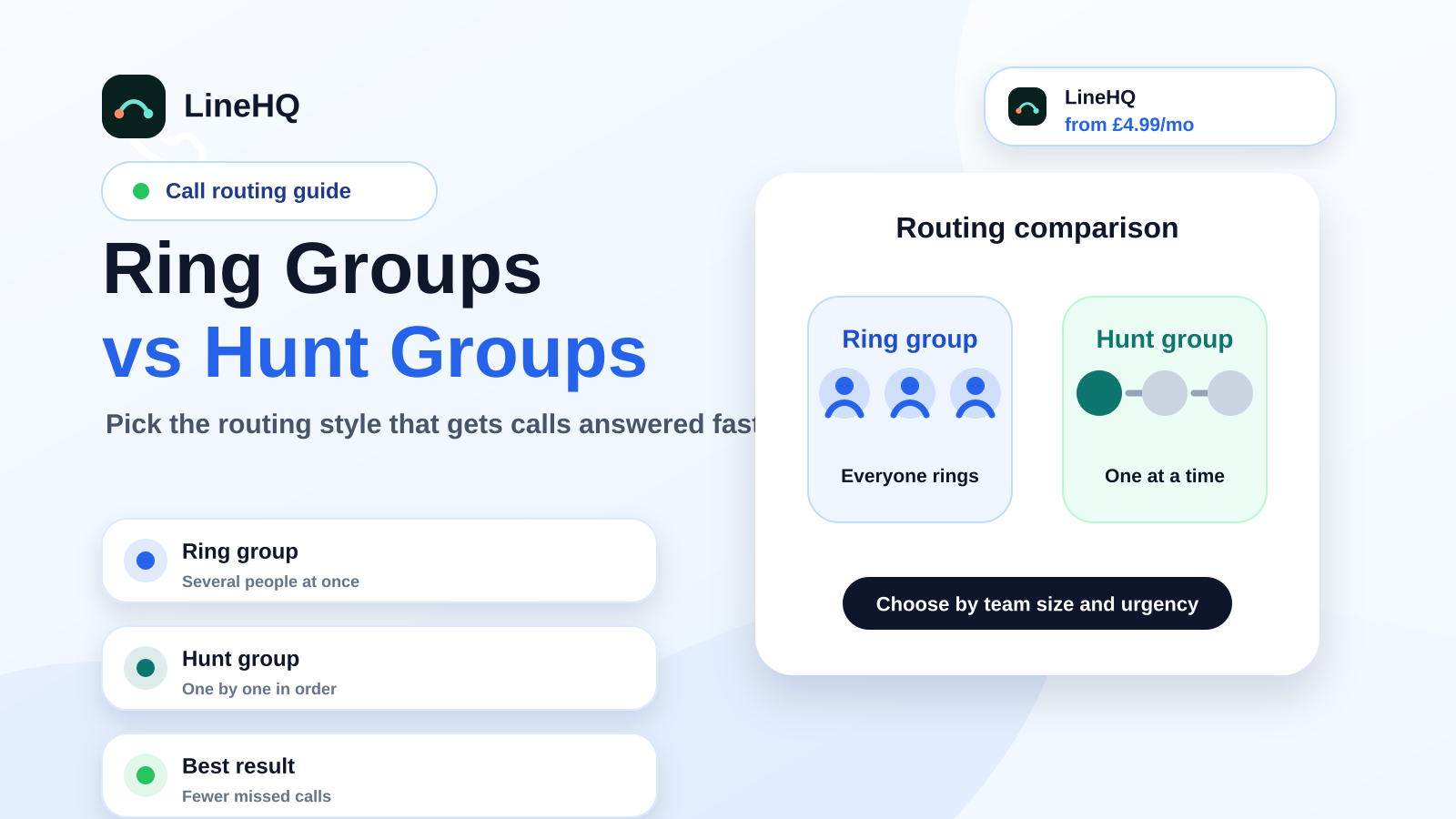
A ring group makes several phones ring at once so anyone available can answer. A hunt group tries people in a set order until someone picks up. For most small UK teams, the better choice depends on call volume, staff roles and whether speed or control matters more.
Last updated: 29 July 2026.
What is a ring group?
A ring group is a call routing setup where one business number rings a group of people at the same time. If a customer calls your main number, LineHQ can send that call to several mobiles, desk phones or team members together. The first person to answer takes the call.
This works well when the call is more important than who answers it. A builder might ring the office manager, the owner and the site supervisor together. A letting agency might ring the front desk and two property managers. The customer gets a faster answer, and the team does not need to pass around a single mobile.
Ring groups are often used with call forwarding, because the phones in the group do not need to sit in one office. They can be mobiles, softphones or other numbers, depending on how your system is set up.
What is a hunt group?
A hunt group sends the call through a list in sequence. The first person gets a chance to answer. If they are busy, unavailable or do not pick up within the set ring time, the system tries the next person. It keeps hunting until the call is answered or reaches the fallback, such as voicemail or a receptionist.
Hunt groups are useful when you want a clear order. Sales calls might go to the sales lead first, then the office, then the owner. Support calls might try the person on duty before ringing a wider team. The customer still calls one number, but the business keeps more control over who handles each call.
What is the difference between a ring group and a hunt group?
The main difference is how the phones ring. A ring group rings several people at once. A hunt group rings one person at a time in a planned order. Both help a business answer more calls from one number, but they suit different team habits.
| Feature | Ring group | Hunt group |
|---|---|---|
| How calls ring | Several phones ring at the same time. | Phones ring one after another. |
| Best for | Fast pickup when anyone in the team can help. | Ordered handling when calls should go to specific people first. |
| Customer experience | Usually quicker, but can feel busy internally. | More controlled, but may add a short wait. |
| Team impact | Everyone in the group gets interrupted by the same call. | Only one person is interrupted at each step. |
| Good fallback | Voicemail, receptionist or overflow team if nobody answers. | Next person, voicemail or receptionist after the final step. |
When should a small business use a ring group?
Use a ring group when missed calls are the main problem and several people are equally able to answer. It is a good fit for trades, clinics, agencies, workshops and local service businesses where customers usually need a quick response rather than one named person.
A ring group can be especially helpful when staff move around. The business keeps one public number, while calls can ring the right mobiles behind the scenes. That is cleaner than putting personal mobile numbers on vans, websites, invoices and Google profiles.
Ring groups do have a downside. If too many people are included, every call becomes a team-wide interruption. Keep the group tight. Start with the people who can actually help the caller, then send unanswered calls to a virtual receptionist or voicemail rather than ringing everyone forever.
When should a small business use a hunt group?
Use a hunt group when calls should follow a priority order. This is common when one person owns a type of enquiry, but the business still needs cover if they are busy. It gives the first-choice person the call without making the customer start again if they miss it.
For example, a small accountancy firm might send new enquiries to the office manager first, then a partner, then a receptionist. A repairs business might route emergency calls to the on-call engineer before trying the main office. That order matters, because the first person usually has the right context.
The trade-off is time. If each step rings for too long, callers wait. A practical setup might ring each person for 10 to 15 seconds, then move on. After the final step, send the call somewhere useful: a receptionist, voicemail-to-email or an out-of-hours message.
How would this work for a small team?
Imagine a five-person electrical contractor. The business advertises one local business number and wants calls answered during the working day.
- New sales enquiries ring the office and the owner at the same time.
- Existing customer calls try the office first, then the project manager.
- Emergency calls go to the duty engineer first, then the owner.
- Unanswered calls go to voicemail-to-email with the caller's number and message.
That setup uses both ideas. The first route is a ring group because speed matters. The second and third routes behave more like hunt groups because the order matters. A small-business phone system should let you mix the two instead of forcing one rule for every call.
How does LineHQ handle ring groups and hunt groups?
LineHQ helps small businesses route calls from one professional number to the right people. You can use a business phone number, forward calls to mobiles, build simple team routing and add a receptionist-style fallback when nobody is free.
The aim is not to make phone setup complicated. Most teams need a few sensible rules: who should answer first, who can cover, what happens after hours and where missed calls should go. That is where a phone system for small teams is usually more useful than another personal mobile.
Which option should you choose?
Choose a ring group if the caller can speak to anyone in the team and your main goal is a fast answer. Choose a hunt group if calls need to follow a sensible order and you want to protect the wider team from unnecessary interruptions.
Many businesses end up using both. Sales calls might ring two people together. Support calls might try one person, then another. Out-of-hours calls might skip the team and go straight to a message or receptionist. The best setup is the one your team can actually live with every day.
FAQs
Is a ring group the same as call forwarding?
No. Call forwarding sends a call from one number to another destination. A ring group is a routing rule that can send the same call to several destinations at once. A ring group often uses forwarding in the background.
Is a hunt group better than a ring group?
Not always. A hunt group is better when calls need an order. A ring group is better when any available person can answer and speed matters most. Small teams often use both for different call types.
Can ring groups send calls to mobile phones?
Yes. A virtual phone setup can ring mobiles as part of a group, so staff do not need to sit beside a desk phone. This is useful for trades, mobile teams and businesses with hybrid working.
What happens if nobody answers?
The call should go to a fallback such as voicemail, voicemail-to-email, another team member or a virtual receptionist. Do not leave callers ringing with no end point. That is how good enquiries get lost.
Do I need a full phone system for this?
You do not always need a large office phone system. Many small businesses only need one business number, a few routing rules and a reliable fallback. LineHQ is built around that lighter setup.