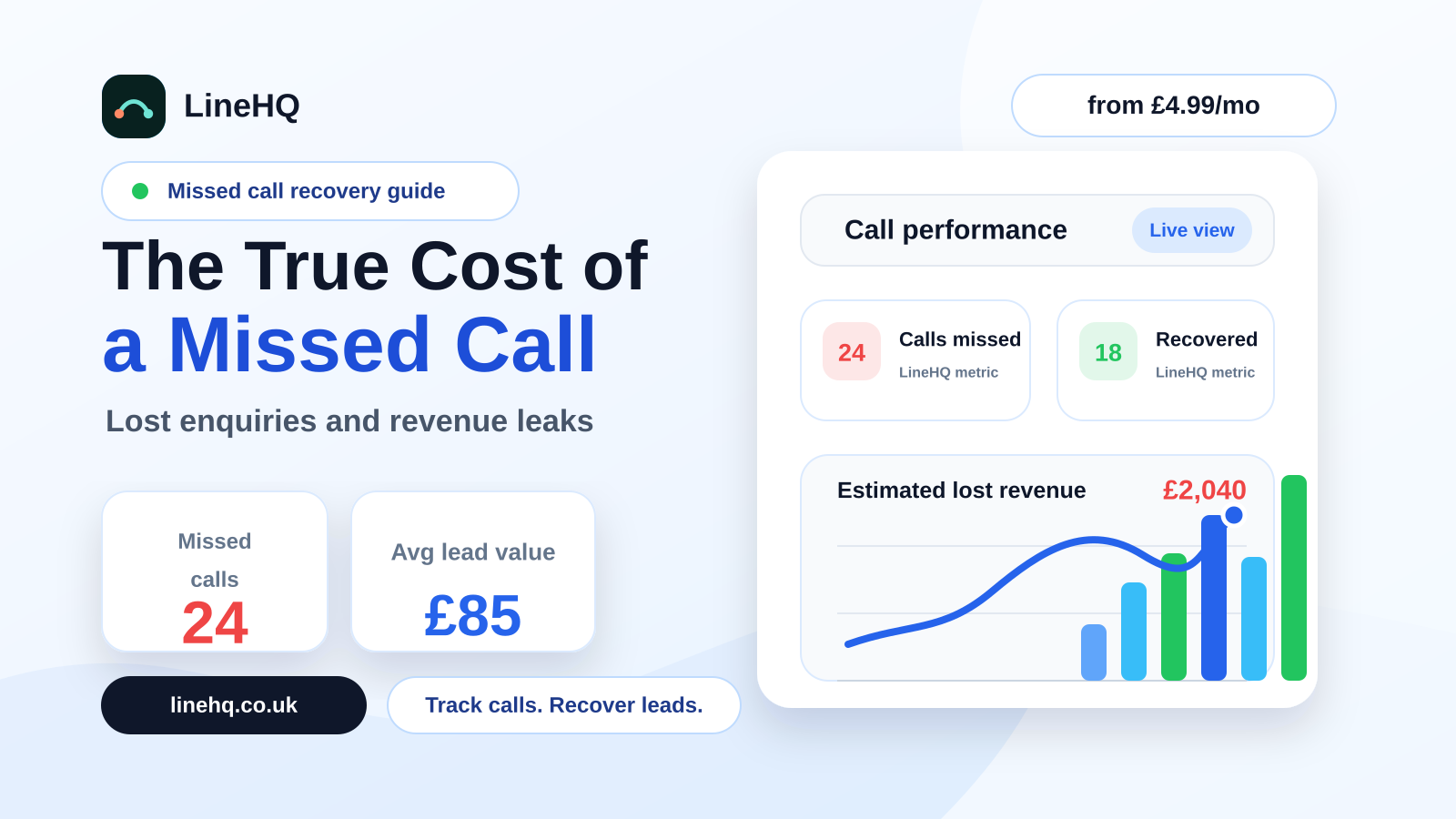
A missed call can cost a UK small business the whole enquiry, not just a few minutes of delay. Recent survey coverage says 1 in 5 UK customers will not try again after an unanswered first call, so the real cost depends on your lead value, answer rate and how quickly you follow up.
This is an external-data guide. No anonymised LineHQ call dataset was available for this article, so the examples below use cited survey findings and simple maths rather than original LineHQ customer data.
Why does one missed call matter so much?
Phone enquiries are often high-intent. The caller has a problem now: a leak, a booking, a quote request, a cancellation, a repair, a complaint, or a question before they buy. If nobody answers, they may not wait neatly for a callback.
PR Newswire's coverage of Rinkel's UK missed-call survey reported that 1 in 5 UK customers will not try again if a business fails to answer the first time. It also reported that 93% of small business owners said they had missed important calls because they were too busy. Source accessed 4 August 2026: No Second Chances: 20% of UK Customers Won't Call Back After a Missed Call.
That does not mean every missed call loses money. Some callers leave voicemail, some ring back, and some were not good-fit customers anyway. But it does mean answer rate belongs in the same conversation as advertising spend, website conversion and repeat business.
How do you calculate the cost of missed calls?
Use a simple model. You do not need perfect numbers to see whether missed calls are becoming expensive.
| Input | Example | What to use in your business |
|---|---|---|
| Missed sales calls per month | 20 | Use call logs, mobile history or call analytics. |
| Callers who do not try again | 20% | Use your own data if you have it; otherwise treat survey data as a warning sign. |
| Likely lost enquiries | 4 | Missed calls multiplied by no-callback rate. |
| Average job or order value | £250 | Use your average invoice, first booking or quote value. |
| Potential revenue at risk | £1,000 | Lost enquiries multiplied by average value. |
For a small trade or service business, 20 missed sales calls a month with a £250 average job value could put roughly £1,000 of monthly revenue at risk if 1 in 5 callers give up. That is not a guarantee. It is a planning figure, useful enough to decide whether better call handling is worth fixing.
Do missed callers go to competitors?
Some will. Salesforce's State of the Connected Customer research found that 88% of customers say the experience a company provides is as important as its products or services, and that 71% of consumers switched brands at least once in the previous year. Source accessed 4 August 2026: Salesforce customer engagement research.
That source is not specifically about missed calls, so it should not be stretched too far. The sensible takeaway is narrower: customers have options, and a poor contact experience makes it easier for them to choose another one. In urgent local services, that next option is often the next business in Google results.
Where do small businesses usually lose calls?
The common points are not complicated. They are the moments where the person with the phone is busy, unavailable or unsure what should happen next.
- Calls arrive while the owner is driving, on-site or with another customer.
- The business number is a personal mobile with no shared visibility.
- Voicemail is switched off, full, unclear or checked too late.
- Out-of-hours calls get the same treatment as daytime calls.
- One person answers everything, even when a second person could help.
- Missed-call history is not reviewed, so busy hours stay invisible.
If you work in the trades, LineHQ's phone number for tradesmen page explains how a business number can ring your mobile without putting your personal number on quotes, vans or directories.
Which fixes reduce missed-call cost fastest?
Start with the fixes that catch live calls and make callbacks easier. A bigger phone system is not always needed.
| Problem | Practical fix | LineHQ link |
|---|---|---|
| Owner cannot always answer | Forward calls to a mobile, then another person if the first does not pick up. | Call forwarding |
| Messages get missed | Send voicemail notifications to email so they are visible and shareable. | Voicemail-to-email |
| Team calls depend on one person | Use ring groups or ordered routing so more than one person can answer. | Small business phone system |
| Callers need a simple route | Use a short greeting or menu for sales, support or existing customers. | Virtual receptionist |
| Busy periods are guesswork | Review missed calls, answer rate and busy hours before changing staffing. | Business call analytics |
What should your missed-call process look like?
- Separate sales calls from personal calls. Use a business number so work enquiries are trackable.
- Decide who answers first. For a sole trader, that may be the owner. For a small team, ring the right person first.
- Add a fallback. If the first person misses it, forward to a second phone or voicemail-to-email.
- Set business hours. Tell callers what happens when the business is closed and when messages are checked.
- Call back quickly. Treat missed sales calls like fresh leads, not admin to clear at the end of the week.
- Review patterns monthly. Look for repeated missed calls at lunch, after 5pm, Monday mornings or during site work.
The aim is not to answer every call at any cost. It is to stop good enquiries disappearing because the call had nowhere sensible to go.
When is a missed call less urgent?
Not every missed call deserves the same response. Existing suppliers, obvious spam and non-urgent admin can wait. New enquiries, booking changes and unhappy customers should sit higher in the queue.
This is where call notes, voicemail and summaries help. If you can see who called, hear what they wanted and spot urgency quickly, you can call back in the right order. Without that, every missed call looks the same until someone wastes time chasing it.
FAQs
How much does a missed call cost?
There is no universal figure. The cost depends on how many calls you miss, how many callers give up, your conversion rate and your average job value. Use a simple monthly estimate rather than a generic industry number.
Is voicemail enough for a small business?
Voicemail is useful, but only if callers trust it and someone checks it quickly. Voicemail-to-email is better than a message trapped on one handset because the team can see it and act sooner.
Should I use call forwarding or a receptionist menu?
Use call forwarding when most callers need the same person or team. Use a receptionist menu when callers have clearly different needs, such as new sales, existing customers and suppliers.
Can a virtual number help with missed calls?
Yes. A virtual number can forward to mobiles, route by time of day and fall back to voicemail. It also gives you call history, so you can see whether missed calls are a real pattern.
What should I check first?
Check the last month of missed calls. Look at when they happened, whether they were called back, and whether any became lost quotes, complaints or repeat enquiries. That tells you where to fix the flow first.