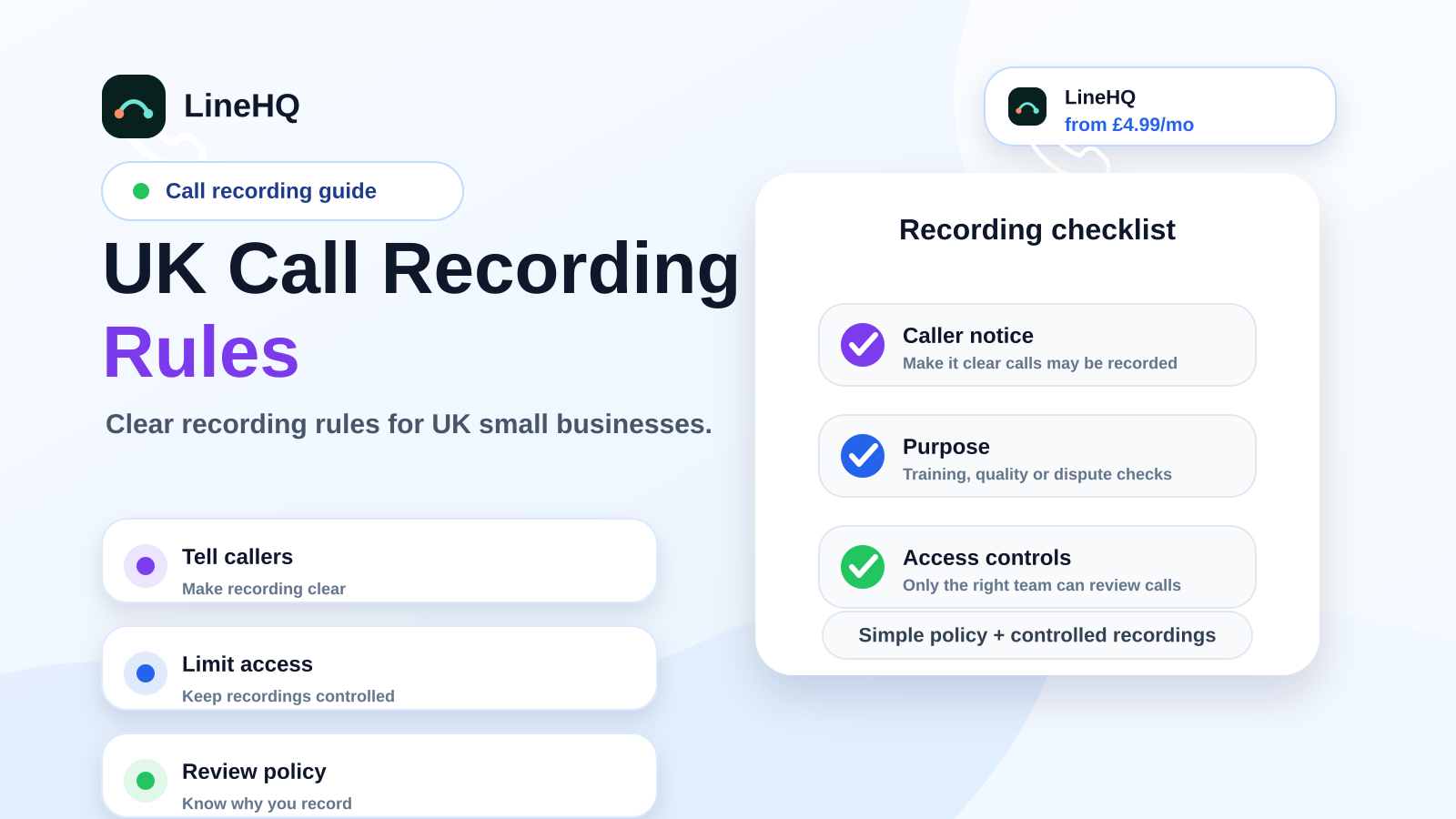
UK small businesses can record calls when they have a clear reason, tell callers before recording starts and handle recordings as personal data. That means choosing a lawful basis, limiting access, setting retention periods and keeping a short policy that explains how recordings are used.
This guide is general information, not legal advice. If you work in a regulated sector, handle sensitive information, or are unsure how UK GDPR applies to your business, speak to a qualified adviser.
For the product setup, see LineHQ call recording. For the service wording customers should read, keep the call recording policy easy to find from your website and call-flow notes.
Is call recording legal for UK small businesses?
Call recording is not automatically banned in the UK. Businesses can record calls when they have a proper reason, tell people clearly, and handle the recordings in line with data protection law.
The UK GDPR and Data Protection Act 2018 focus on fair, lawful and transparent use of personal data. A recorded call may contain names, phone numbers, addresses, payment discussions, health information, business details or other personal information. That means the recording needs to be treated as personal data.
Tell callers before recording starts
For most small businesses, the simplest approach is to play a short announcement before recording begins. It should be plain and specific enough for callers to understand what is happening.
For example:
Calls may be recorded for training, quality and record-keeping purposes.
That type of message is better than hiding the information in a privacy policy that callers may never see. If a caller continues after hearing the announcement, they have at least been made aware that recording is taking place.
Some businesses may need more detail, especially if calls involve sensitive information. The announcement does not have to explain your entire privacy policy, but it should not be vague or misleading.
Choose a lawful basis
Under UK GDPR, you need a lawful basis for processing personal data. For call recording, this is often legitimate interests, contract, legal obligation, or consent depending on the reason for the recording and the type of call.
Consent is not always the best fit for business call recording. If you rely on consent, it must be freely given, specific, informed and easy to withdraw. Many businesses instead assess whether recording is necessary for a legitimate business purpose, such as training staff or keeping an accurate record of customer instructions.
The important point is to decide your lawful basis before recording, document it, and explain it in your privacy information.
Record for a clear purpose
Do not record calls just because the feature is available. A sensible policy starts with the reason.
Common purposes include:
- checking order details or appointment information
- training staff and improving customer service
- handling complaints or disputes
- keeping a record of important business instructions
- meeting sector-specific compliance requirements
If the purpose is not clear, recording may be harder to justify. If the purpose changes later, the business should review whether the same lawful basis and privacy information still apply.
What should small businesses do before enabling recording?
| Do | Do not |
|---|---|
| Tell callers before recording starts | Hide the notice only in a privacy policy |
| Write down the purpose and lawful basis | Record every call just because the feature exists |
| Limit access to people who need recordings | Email audio files around the business |
| Set a retention period and review it | Keep recordings forever by default |
Keep recordings only as long as needed
A common mistake is keeping recordings indefinitely. UK data protection principles say personal data should be kept for no longer than necessary.
Set a retention period that matches the reason for recording. A small service business may only need recordings for a short complaint window. A regulated business may need a longer period. Either way, the retention period should be deliberate, written down and followed.
LineHQ's call recording feature lets businesses choose recording per number and use retention settings so older recordings can be pruned automatically.
Store recordings securely
A call recording can contain private information. Treat it like any other customer record.
- Limit access to people who genuinely need it.
- Use secure systems rather than sending recordings around by email.
- Keep account access protected with strong passwords and sensible permissions.
- Delete recordings when the retention period ends.
- Have a process for handling access or deletion requests.
Security matters even for very small businesses. A sole trader with recordings in a shared inbox still has responsibility for how that information is stored and shared.
What should a call recording policy include?
A simple internal policy is enough for many small businesses. It should cover:
- which numbers or call types are recorded
- why calls are recorded
- the lawful basis being relied on
- the wording of the caller announcement
- who can access recordings
- how long recordings are kept
- how callers can ask about their data
- how recordings are deleted or exported if needed
The policy does not need to be complicated. It needs to be clear enough that staff know what to say, what to do, and when not to share a recording.
Do all calls need to be recorded?
No. In many small businesses, only some lines need recording. For example, a sales or booking line may need an accurate record, while a general mobile forwarding line may not.
Recording per number is useful because it avoids a blanket approach. You can switch recording on where it has a clear purpose, and leave it off where it does not.
A practical checklist before switching call recording on
- Write down why you need the recordings.
- Choose and document the lawful basis.
- Add a short caller announcement.
- Update your privacy information.
- Set a retention period.
- Decide who can access recordings.
- Check whether your sector has extra rules.
- Review the setup regularly.
How LineHQ helps
LineHQ is built for small UK businesses that want useful phone features without running a complicated phone system. Call recording can be enabled per number, callers can hear an automatic announcement, recordings are played back securely in the dashboard, and retention can be controlled.
If you want recording for training, quality or record-keeping, start with the LineHQ call recording page. If you are still choosing your business number, compare virtual phone numbers, virtual landlines and call forwarding first.
The best setup is simple: tell callers clearly, record only where there is a real purpose, keep recordings secure, and delete them when they are no longer needed.
Frequently asked questions
Do I need consent to record business calls in the UK?
Not always. Consent is one possible lawful basis, but many businesses rely on another basis such as legitimate interests, contract or legal obligation. You still need to tell callers clearly and document your reason for recording.
Is a call recording announcement enough?
An announcement is a good start because it makes recording transparent at the point of the call. You should also have privacy information that explains your purposes, lawful basis, retention period and caller rights in more detail.
How long should a small business keep call recordings?
Keep them only as long as needed for the purpose you recorded them for. That might be weeks, months or longer depending on your business and sector. The key is to set a clear retention period and follow it.
Can I record only some business numbers?
Yes. Recording per number is often the cleanest approach. It lets you record calls where there is a real business need and leave recording off where it is unnecessary.